
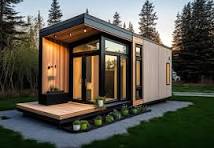
The tiny home movement has captured the imaginations of many seeking simpler, more sustainable lifestyles. But, is this trend really all it’s cracked up to be? Jacqueline Urick, who lives in a 540-square-foot home in Sturtevant, WI, with her beloved dog, Spice, the answer is a resounding yes.—there’s something undeniably appealing about the idea of trading in a massive mortgage for a cozy, affordable space that’s all your own.
Tiny Homes: Big on Benefits
The average American home has been steadily growing in size, averaging over 2,400 square feet as of recent reports. In contrast, tiny homes usually range between 100 and 600 square feet. But despite their small footprint, these homes often come with a surprising list of benefits:
- Financial Freedom
Tiny homes can drastically cut costs. The average cost to buy and build a tiny home is around $30,000 to $60,000—significantly less than a traditional house. This was one of the big draws for Urick, who purchased her 540-square-foot Quonset hut for only $35,000! And without a big mortgage payment, tiny homeowners can focus on other priorities, from travel to education. - Environmental Impact
Living in a tiny home has a naturally smaller environmental impact. Tiny homes use fewer resources in both construction and day-to-day energy. Many people also install solar panels or use energy-efficient appliances, further lowering their carbon footprint. In Urick’s case, heating and cooling a small space means her utility bills are incredibly low. According to a study by the National Association of Home Builders, tiny homes use around 45% less energy than traditional homes. - Clutter-Free Living
In a tiny space, you’re forced to make choices about what you truly need. Urick, for example, had to give up on impulse buys and say goodbye to “just-in-case” items. Tiny homes encourage a minimalist lifestyle, which many find both liberating and calming. Every item in the home serves a purpose, and in a space with minimal clutter, many people report reduced stress levels and an easier time staying organized.
The Challenges of Tiny Living
Of course, tiny living isn’t all roses and savings accounts. There are some trade-offs, and it takes a certain mindset to thrive in a small space.
- Space Constraints
Let’s be honest—tiny homes come with the obvious limitation of less space. Jacqueline Urick admits that having more than three guests over can make her space feel cramped. For some, entertaining might be challenging in such small quarters, so it’s something to consider if you’re used to hosting large gatherings. - Higher Cost per Square Foot for Renovations
Interestingly, renovating a tiny home can be more expensive than expected, often costing more per square foot than a larger house. Urick discovered this firsthand. She spent about $110,000 on her renovations, dealing with high foundation repair costs and the difficulty of finding contractors willing to take on a tiny project. Due to the unique challenges (like curved walls in her Quonset hut), not all contractors were willing to work on the space, and those who did charged more. - Storage and Lifestyle Adjustments
Adapting to a tiny home usually means changing lifestyle habits—like cutting back on impulse buys and opting for quality over quantity. Urick’s closet, for instance, was so compact that each new piece of clothing required her to part with an old one. But while it might feel restrictive at first, this intentional living often leads to more thoughtful purchases and an appreciation for what you truly need.
Who’s Joining the Tiny Home Movement?
The tiny home lifestyle appeals to a wide range of people. Millennials and younger generations often view tiny homes as a path to financial freedom and a more sustainable lifestyle. But it’s not just young folks jumping in—retirees are increasingly opting for tiny homes to downsize and simplify, freeing up more funds for travel and new experiences. For anyone prioritizing sustainability, flexibility, and financial independence, tiny homes present an enticing alternative.
Thinking About Going Tiny? Here’s What to Consider
If you’re inspired by the idea of tiny living, start by thinking about your non-negotiables. What aspects of your current lifestyle are you willing to adapt? And what would make a tiny home feel like “home” to you? While tiny homes offer many perks, they’re not for everyone. But for people like Urick, they’ve become the ultimate solution for living simply, saving money, and focusing on what truly matters.
As the housing market continues to evolve, tiny homes are proving they’re more than just a passing trend. They’re a testament to living intentionally, cutting back on waste, and making room—quite literally—for a life focused on experiences over excess. So if you’re feeling the itch to live small, know that a giant leap forward might just mean scaling down.
https://www.realtor.com/news/trends/best-tiny-house-in-america/
If you’re considering a move or investment and require a trusted Real Estate Broker, we’re here to assist you. Contact us via email at TEAM@McDanielCallahan.com, complete the form below, or give us a call at 925-838-4300. We are ready to provide expert guidance and support for all your real estate needs. Terry McDaniel DRE License #00941526


 Find a Broker™